What Nobody Tells You About Making a Living as an Artist
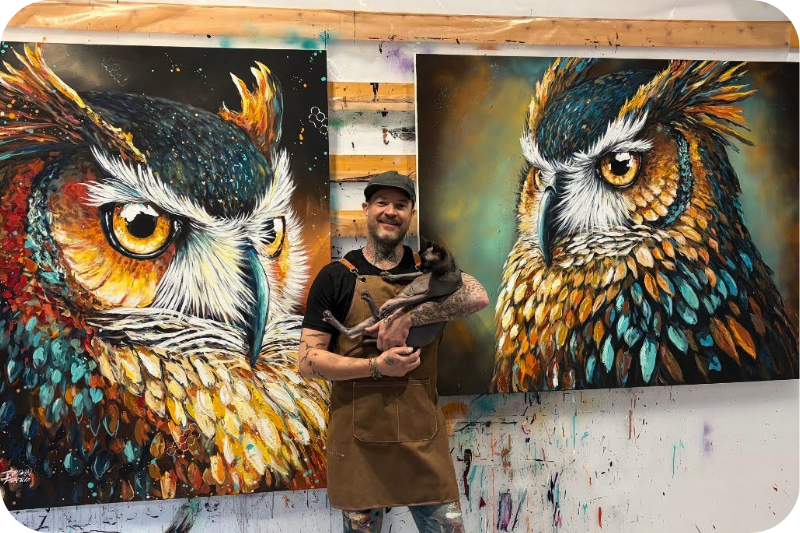
Jordan Perkins didn't plan on becoming an artist.
In 2015, he went to Dollarama with his five-year-old daughter, bought some cheap art supplies, and started painting with her. She stopped after about a week. Jordan didn't. He kept painting, mostly for himself, until someone asked if he could paint their dog and offered him around $250–$300. He said yes, finished the painting, and suddenly had his first paid commission.
That one commission turned into another, then another, and eventually into a full-time career. Today, Jordan is a self-taught artist based in Coldstream, British Columbia, Canada, known for his colorful paintings of animals and people. But what makes his story interesting isn't just that he managed to make art his job. It's how much of his career came from learning everything around the art.
You Have to Treat Art Like a Business
Before becoming an artist, Jordan spent years working in restaurants. He learned how to deal with people, market things, handle chaos, understand customers, and, most importantly, sell.
When you're trying to make a living as an artist, those skills matter just as much as what happens on the canvas. You can be incredibly talented, but if nobody sees your work, knows how to buy it, or has a reason to remember you, the talent doesn't automatically turn into an income.
Jordan doesn't romanticize that part. He thinks about what will sell, where his paintings will be seen, what materials cost, and how to keep people coming back. His art is still art, but it's also a business.
And that doesn't make it less authentic.
You Don't Need Expensive Tools to Make Good Art
Jordan is also pretty serious about not overspending. He has used roughly the same range of paints for most of his career and isn't interested in convincing himself that expensive materials are what separate a professional from a beginner.
His comparison is simple: give Jimi Hendrix a cheap guitar and he's still Jimi Hendrix.
There can be a weird pressure when you're starting out to buy the “right” supplies, the perfect equipment, the expensive camera, the professional website, the fancy studio. But none of that creates your artistic voice. Jordan's advice is to use what works, keep your costs sensible, and spend money when there's an actual reason for it.
Getting Seen Is Part of the Job
One of Jordan's biggest lessons is that making the work is only half of it. People have to actually see it.
He estimates that thousands of people might see a painting before one person decides to buy it. That's why he puts his work everywhere he can. Social media, restaurants, commissions, live painting events, collectors, word of mouth. Every place gives the work another chance to find someone.
He's built relationships with around 20 restaurants that display his paintings. When something sells, he replaces it with another piece instead of taking a commission from the restaurant. It keeps his work visible and gives more people a chance to discover him.
That's art marketing without making it feel like marketing.
The more places your work exists, the more chances someone has to find it.
Sometimes People Are Buying You, Too
Jordan talks a lot about collectors, but not just in the traditional art-world sense. He believes there's a difference between someone who buys a painting and someone who starts buying the artist.
Once someone knows your work, follows what you're making, and comes back for another piece, the relationship changes. They're not just looking for something to put on their wall. They're interested in what you do next.
That's why finding art collectors isn't only about convincing someone to buy one painting. It's about building enough of a connection that they want to stay around.
And you can't force that. You have to keep showing up, keep making the work, and let people find their way into it.
You Don't Have to Make Money in Just One Way
Jordan doesn't depend on a single source of income. He sells original paintings, takes commissions, offers prints, works with restaurants, and paints live at charity events.
Some of those things are more predictable than others. Some give him creative freedom. Some put him in front of new audiences.
His charity work eventually became a major part of what he wanted his career to mean. He reached out to charities himself, offered to paint live at their galas, and has helped raise around $90,000 through those events over two years.
At some point, the question stopped being just “How much art can I sell?”
It became “What can I do with the position I've built?”
You Don't Have to Follow the Traditional Art World
Jordan isn't particularly interested in doing things just because that's how the art world has always done them. He doesn't rely heavily on galleries, doesn't follow one strict pricing formula, and isn't convinced that every artist needs to fit into the traditional system to have a legitimate career.
His prices depend on the size of the work, what it took to make, and sometimes simply how much he likes the painting.
The point isn't that every artist should copy Jordan. It's that there isn't one correct way to build an art career.
You have to find the people who want what you make, figure out how to reach them, and build a business around that relationship.
So What Does Success Actually Look Like?
Jordan started out wanting to sell paintings and make money. Eventually, his priorities changed.
A friend once asked him what his legacy was going to be. That question pushed him toward charity work, fundraising, and thinking about what he could leave behind beyond the paintings themselves.
He also has a simple philosophy: “Happy is happy.”
And maybe that's the part that gets lost when we talk about making a living as an artist. It's easy to focus on followers, sales, galleries, prices, and exposure. Those things matter. But they're supposed to help you build a life you actually want, not become the entire point of it.
Jordan's career started with a kid, some cheap paint, and no real plan.
It grew because he kept painting, kept learning, kept putting his work in front of people, and eventually learned how to build a business around what he loved.
You don't have to have it all figured out either.
You just have to keep the snowball moving.
Watch the Full Episode
Want to hear Jordan talk about all of this in his own words? Watch the full Artists Unveiled episode with Jordan Perkins, where he gets into his first commission, building an art business, finding collectors, pricing his work, making money from different revenue streams, charity painting, and what it actually takes to build a sustainable creative career.
