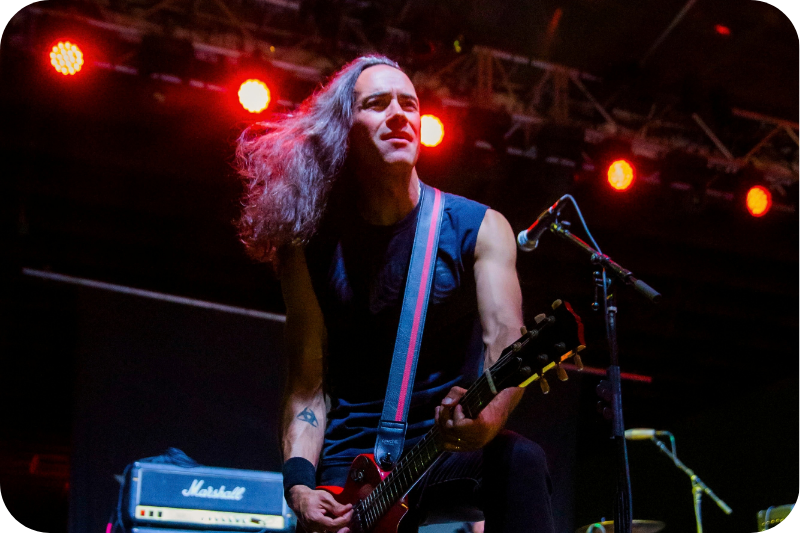
What Does a Broadway Musician Actually Do? Inside Aurelien Budynek’s Creative Career
What does a Broadway musician actually do? There is a lot more to it than playing an instrument during a show. Broadway musicians are part of a huge creative and technical process that involves rehearsals, sound design, programming, collaboration, and adapting to constant changes. For guitarist Aurelien Budynek, that has meant everything from building guitar sounds for The Lost Boys to performing with some of the biggest names in music.
Aurelien returned to the Artists Unveiled podcast to talk about what he has been working on since his last appearance, and his career has taken him in some pretty incredible directions.
Inside The Lost Boys
Aurelien's latest Broadway experience has been The Lost Boys, the stage adaptation of the 1987 cult classic film.
He joined the production long before opening night, starting with a workshop and eventually becoming involved in rehearsals, programming guitar sounds, and preparing both the pit band and musicians performing on stage.
That process can get surprisingly technical.
Different scenes require completely different guitar sounds, so Aurelien worked with the music team to create effects that matched the mood, tempo, and energy of each part of the show. Some sounds needed to be dreamy, others aggressive or rhythmic. Effects could also be triggered automatically through clicks and timecode so everything stayed synchronized with the rest of the production.
Then came previews, where the show was tested in front of real audiences.
Songs were changed, sections were rewritten, and sometimes new material appeared overnight. For Aurelien, it was one of the most intense preview processes he had experienced.
Once the show opened, the major changes stopped, but the experience was still different every night. Actors rotate, energy shifts, and every audience brings something new into the room.
From Broadway to Marky Ramone
Aurelien's music career stretches far beyond theater.
He recently reunited with Marky Ramone, returning to music he had played almost a decade earlier. They played festivals and club shows across the US, including performances in New York and Chicago.
Playing with Marky comes with its own responsibility. The Ramones catalogue is deeply familiar to fans, so Aurelien approaches those songs with a lot of respect for the original recordings.
There is a certain discipline involved in knowing when to bring your own personality into a performance and when the music itself needs to lead.
For Aurelien, being part of that legacy is about giving longtime fans an experience that feels true to the music they love.
A Completely Different Musical Language
His work with Cindy Blackman Santana requires almost the opposite approach.
Aurelien has been playing in Cindy's band for more than 15 years, and the music is highly improvisational. The band listens and responds to each other in real time, meaning the same song can go somewhere completely different every night.
That ability to move between precision and improvisation has become an important part of Aurelien's career.
It also led to one of his most memorable recent experiences: performing with Carlos Santana.
During a performance with Cindy's band at SFJAZZ, Carlos joined them on stage for two nights. Aurelien had been a longtime fan and remembers how difficult it was to concentrate the first time Carlos was watching him perform.
Years later, he was sharing the stage with him.
The experience became even more special when Carlos told Aurelien, “Thank you for your gift” after a performance.
Aurelien later contributed to Cindy's album Coherence, recording alongside Cindy and Carlos and even becoming a co-writer on one of the songs.
The Hidden Side of Being a Modern Guitarist
One of the biggest things Aurelien has learned recently is sound design.
Being a professional guitarist today can involve a lot more technology than people might expect. Guitar sounds can be programmed to change automatically with the music, while effects, clicks, and timecode keep everything synchronized with the production.
For Aurelien, learning how these systems work has opened up another creative side of being a musician.
A sound might feel perfect when heard on its own, but once the entire band, stage, lighting, actors, and audience are involved, it can read completely differently.
That is where technical knowledge becomes part of the creative process.
The People Behind the Career
Despite all the different projects, Aurelien keeps coming back to one thing: collaboration.
Whether he is working with a small band or a Broadway production involving hundreds of people, everyone has a role. Musicians, actors, crew, technicians, producers, and everyone working behind the scenes have to trust each other and do their part.
That has shaped Aurelien's approach to his own career. He talks about building relationships with people you trust, being someone others can rely on, and staying open to learning.
For a session musician or any artist trying to build a career, those relationships can become just as important as the work itself. A project leads to a connection, a connection leads to another project, and over time those circles become your creative community.
There Is No Single Path
Aurelien's career moves between Broadway, touring, recording, film, and live performance. One project demands precision. Another demands improvisation. Another might require completely new technical skills.
That variety is part of being a working creative.
You don't always know what the next opportunity will look like. What you can control is how you show up for the opportunity in front of you, how much you learn from it, and the relationships you build along the way.
Aurelien's story is a reminder that creative careers are built over time. Sometimes that means playing a Broadway show eight times a week. Sometimes it means recreating a legendary catalogue. Sometimes it means learning an entirely new piece of technology.
And sometimes, it means finding yourself on stage playing guitar alongside someone you grew up listening to.
Keep Building Your Creative Career
This conversation is exactly why we created the Artists Unveiled podcast: to hear what creative careers actually look like from the people living them.
If you're a musician, artist, filmmaker, performer, or any kind of creative, your path probably won't look exactly like Aurelien's. That's the point. There is more than one way to build a life around your work.
Find your people. Find your opportunities. Build your creative career on DiMi.
You are welcome to quote or reference this article. For media, editorial, or quotation requests, please contact us at publicrelations@godimi.com
